

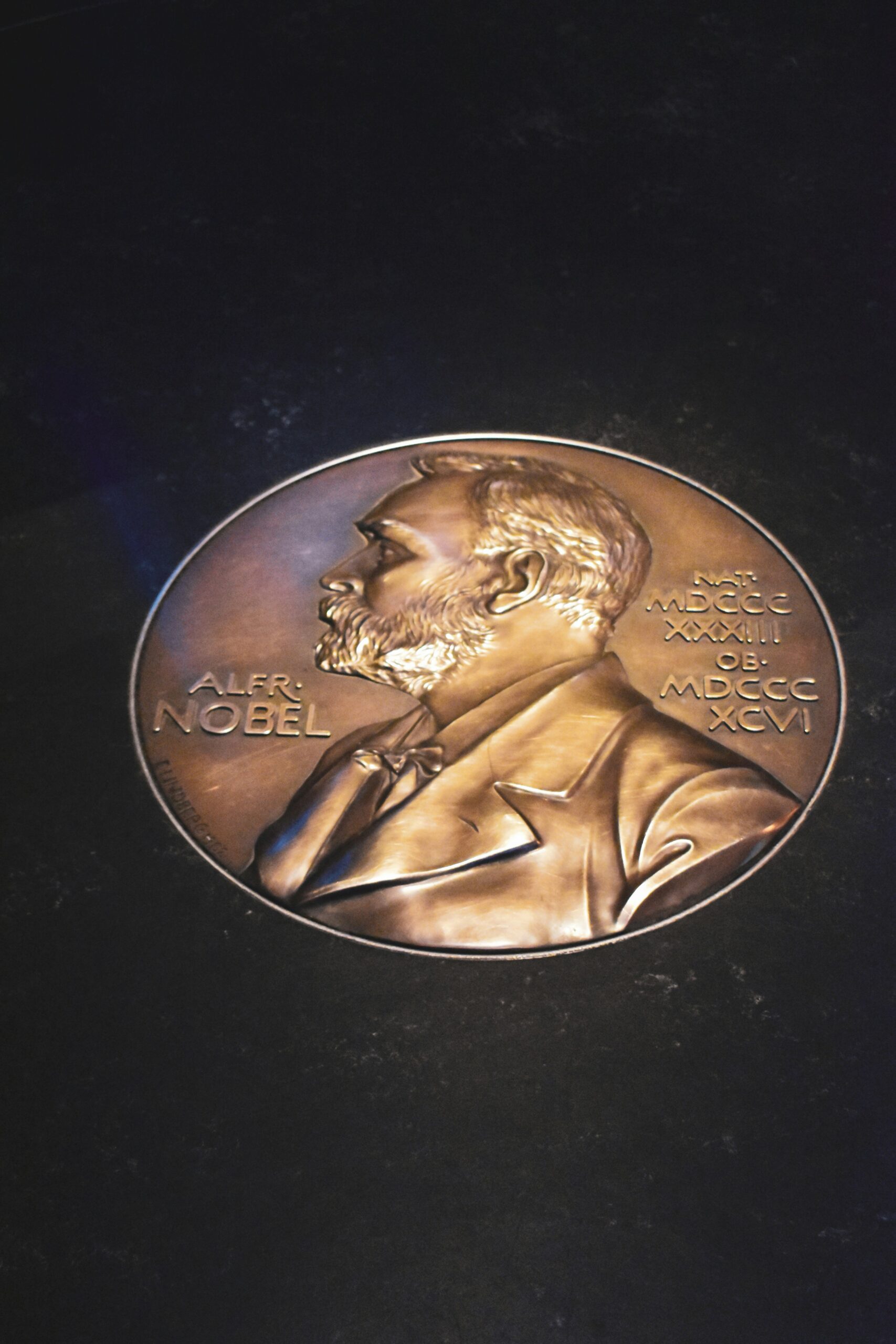
Photo by Anastasiya D on Unsplash
Listen to article here.
Early October is always an interesting and exciting time in certain fields, because that’s when the six Nobel Prizes are announced in medicine or physiology, chemistry, physics, economics, literature and peace. For people who work in these subjects or industries, they are often eager to find out whose discoveries or achievements will be honoured this time; for some, there’s even a hope that maybe this year it could finally be them getting that phone call from Stockholm (or, in the case of the peace prize, that phone call from Oslo). The announcement of the award could be the pinnacle of someone’s career or, conversely, it could be the reason behind crushing disappointment and the worry that their hard work won’t ever be formally recognised.
Perhaps part of the stress and anxiety around the Nobel Prizes or other major awards, such as the Fields Medal for mathematics, or the Oscars or Emmys for acting, or the Turing for computer science and so on, is due to the fact that only one such award is handed out each year, sometimes to just one individual, as in the Nobel Prize for literature or the Golden Globe for best actor, and in some cases to two or three people who have worked together. For every person, pair, trio or small group that is given the award, there are hundreds or even thousands of others who continue to toil and to contribute to their subject area without much acknowledgement. Certainly, many people work at a particular job because they love what they do and they want to make the world a better place, even if in a small way, on a daily basis. But it’s also true that to receive a little bit of gratitude and credit can go a long way. This is important to remember in a workplace.
It’s worth acknowledging that the Nobel Prizes – and all other such awards – are a little controversial. In terms of the Nobel, Alfred Nobel was a Swedish inventor and businessman. He made a fortune when he invented dynamite; while dynamite definitely has its benefits, some people argue that it may also have contributed to the destruction wrought by wars and also led to the deaths of many innocent people. Nobel lived well off this and other inventions and it has been suggested that he tried to assuage his guilt somewhat by writing a will that said he wanted to leave his estate to a foundation that would honour important human – and ideally humane – achievements. A further controversy is that only certain fields are recognised by the Nobel Prizes; besides the lack of mathematics, biology is missing, as are nearly all arts other than literature, the social sciences and still others. This can suggest that those fields are considered to be less vital than the ones that receive an award. Again, this is true of other awards; for each field or individual that is honoured, many others are excluded.
Related to this, many major scientists, writers or activists who are widely considered to have been worthy of the Nobel Prize have not received it, while others who are more or less now forgotten in their fields are viewed as erroneous choices; similarly, some areas within a given field seem to get more attention than others; and some decisions seem very iffy in retrospect. There’s also been plenty of discussion about how biased the Prize committees are and whether their decisions are influenced by geopolitical concerns; as an example, it’s broadly assumed that the literature committee tries not to pick winners from the same nation or same language too often, which means that some of their choices are thought to be forced by such considerations, in turn leading to some literary critics and authors shrugging at or even criticising the Prize in Literature. Furthermore, some recipients of a Nobel have turned it down, such as George Bernard Shaw, or have refused to attend the Award ceremony, not wanting to be linked to such an award or event.
Written by Dr B.J. Woodstein (Research Associate, PILAA)
To read the full article, you must be a PILAA Member.